

Americans love their cats — all 49 million households worth. And nearly every one of them has a litter box that gets scooped, refilled and forgotten without a second thought.
That second thought, it turns out, is worth having.
The math no one is doing
Conventional cat litter is made from sodium bentonite clay, strip-mined from the earth in a process that removes topsoil, disrupts ecosystems and permanently alters land that can take decades to recover. Once mined, the clay is processed, packaged and shipped—often across thousands of miles—to land on a store shelf, get used for a week and end up in a landfill.
Where it will sit, unchanged, for centuries.
Americans go through an estimated 5 billion pounds of clay litter every year. That's as much as 30 to 40 pounds of mined earth moving through a typical household every month, destined for a landfill. All for a product that is, at its core, just dirt.
Multiply that by 49 million cat-owning households. The numbers get uncomfortable fast.
Weight is a bigger deal than you'd think
Here's something that rarely comes up in the sustainability conversation: conventional clay litter is extraordinarily heavy. A month's supply for one cat can run 30 to 40 pounds. That weight doesn't just strain your back, it drives up transportation emissions at every point in the supply chain, from the mine to the warehouse to the store to your car.
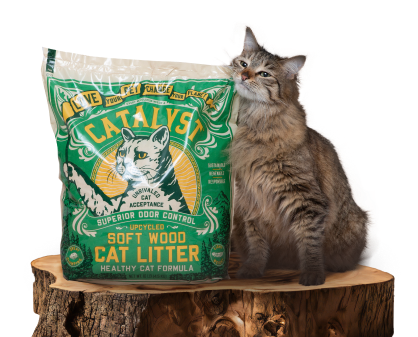
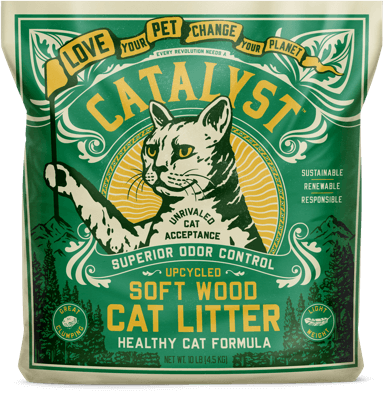
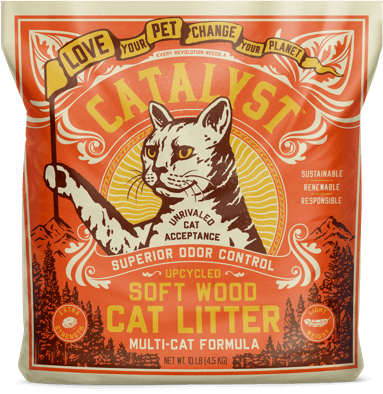
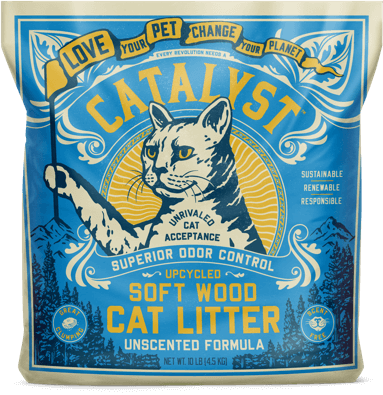
Some newer alternatives, made from plant-based or reclaimed materials, weigh a fraction of their clay equivalent while lasting just as long. Catalyst Pet litter, for example, is made from upcycled softwood fiber, reclaimed from lumber and paper production rather than mined from the ground. A single 15-pound bag covers one cat for two months. That's less mining, less shipping weight and less landfill, from a material that started as industrial byproduct.
The environmental math shifts considerably when a product weighs less and lasts longer.
The price barrier? It's gone.
For a long time, sustainable litter lived on a very specific kind of shelf—specialty pet stores, premium price points and a customer base already willing to pay more to buy better.
That's changed. Sustainable alternatives have moved into mainstream retail with price points that no longer require a trade-off. Catalyst Pet litter is now available at Walmart for under $10 a month—less than most households spend on coffee in a week.
It's the kind of shift that moves habits at scale. Sustainable choices don't go mainstream because people care more—they go mainstream because the friction disappears.
One box. Twice a month. All year.
The biggest environmental wins don't always come from the loudest choices. They come from the quiet, routine ones—the products so ordinary we stop noticing we're choosing them.
A litter box gets refilled roughly twice a month. That's 24 purchasing decisions a year, made mostly on autopilot, adding up to pounds of mined clay and landfill waste that most cat parents have never once thought to question.
This Earth Day, the carbon pawprint conversation starts in the litter box.
Frequently Asked Questions
Is clay cat litter bad for the environment?
Yes. Conventional clay litter is made from strip-mined sodium bentonite, a process that disrupts ecosystems and removes topsoil. After a single use, it goes straight to the landfill, where it stays for centuries.
What is a more sustainable alternative to clay cat litter?
Plant-based and wood-based litters made from reclaimed or upcycled materials are a much lower-impact option. Catalyst Pet litter is made from upcycled softwood fiber, a byproduct of lumber and paper production, and lasts significantly longer than clay.
Is sustainable cat litter expensive?
Not anymore. Catalyst Pet litter is available at Walmart for under $10 a month, and because it lasts longer than clay, you're buying less overall.
How do I switch my cat to a new litter?
Most cats transition smoothly with a gradual mix-in process over 7 to 10 days. Here's Catalyst Pet’s transition guide.